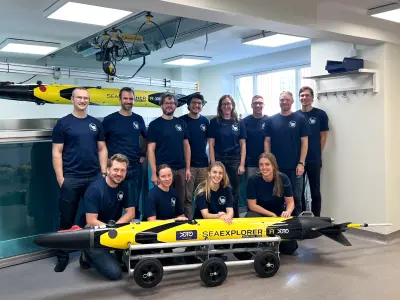
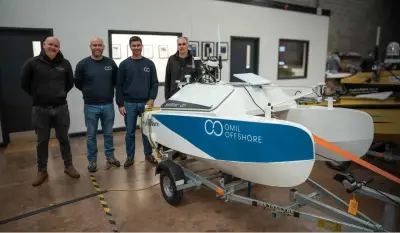
Marine robots now have a real industrial plant to prove themselves in. On 28 October, the K-lab Marine Robotics Centre (KNARR) opened its doors at the Kårstø processing plant in Tysvær, Norway, giving developers a place to test, qualify and refine marine robotic technology in a working environment.
That is what sets KNARR apart. It is the first centre of its kind in Norway - and one of the first in the world - to be connected to a facility in active operation. Instead of moving from lab to real conditions in separate steps, new technology can be developed and tested where it will actually be used.
The centre is open to the wider maritime sector. Its work will cover areas such as inspection, autonomous operations, environmental monitoring, and the security and maintenance of offshore installations. Minister of Research and Higher Education Eileen Fugelsnes officially opened the centre, which builds on Norway’s already strong research community in marine robotics.
Testing and maturing robotic technology
“The Norwegian continental shelf is important for a reliable and secure supply of oil and gas to Europe, and technology is crucial for maintaining oil and gas production and getting more value out of existing fields and infrastructure. At the KNARR centre, we can test and mature technology that makes offshore operations safer, more efficient and more data driven. This is done in close collaboration with suppliers, research communities and industry partners,” says Hege Skryseth, executive vice president for technology, digitalization and innovation at Equinor.
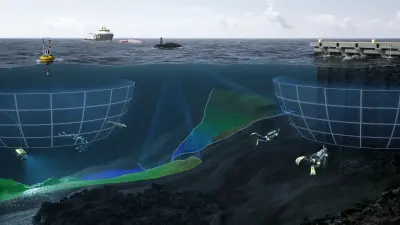
KNARR is an extension of several established test centres for the early phase of technology testing. Three test areas have been set aside in water depths of 25, 140 and 250 metres, respectively.
Three kilometres of subsea cable and associated electronics have been laid to test sensor technology over time. Together with existing power cables, export pipelines and subsea structures, this provides an opportunity to test, among other things, distributed acoustic sensing (DAS). Equinor and Gassco have so far set aside NOK16 million to establish the centre, with the possibility of expanding the facilities for new functionality in the future.
Equinor sees potential cost savings of several hundred million NOK annually by using underwater robots and autonomous vessels in the years to come. “We have set a goal of reducing operational costs significantly by 2035. By using underwater drones for smaller tasks, we can work more efficiently and use the larger vessels where they provide the greatest value,” says Skryseth.
Strengthening competitiveness
Marine robotics will play an increasingly important role in the inspection, monitoring and maintenance of offshore infrastructure. It contributes to employees being less exposed to risk, strengthens operational performance and provides a better basis for decision-making.
“The strong environments we have in advanced robotics and digital technology in Norway are among the strategic advantages that will be able to strengthen our competitiveness in the decades to come. We have a long coast, and a rich maritime industrial history that we want to strengthen through good cooperation across industries such as aquaculture, oil and gas extraction, wind power, shipping and the defence industry”, comments Skryseth.
Technology development is important for achieving better productivity, high value creation and ensuring long-term resource utilization on the Norwegian shelf. KNARR is a platform for developing, testing and demonstrating new solutions that can contribute to safe, efficient and competitive energy operations in the years to come.
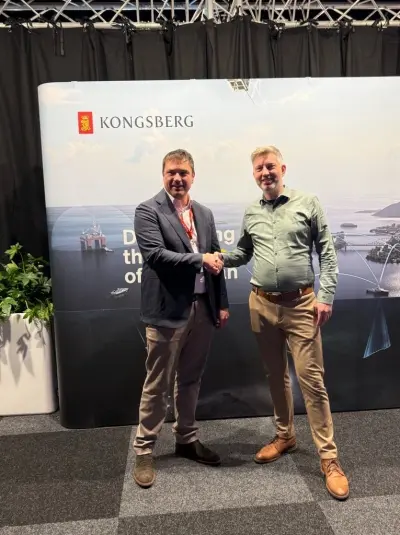
 Eileen Fugelsnes, Minister of Research and Higher Education, and Equinor’s Hege Skryseth (left) at the KNARR opening. (Image courtesy: Torstein Lund Eik / Equinor)